
Australia-European Union Free Trade Agreement: Trade and Beyond
Abby Deng | Europe & Eurasia Fellow
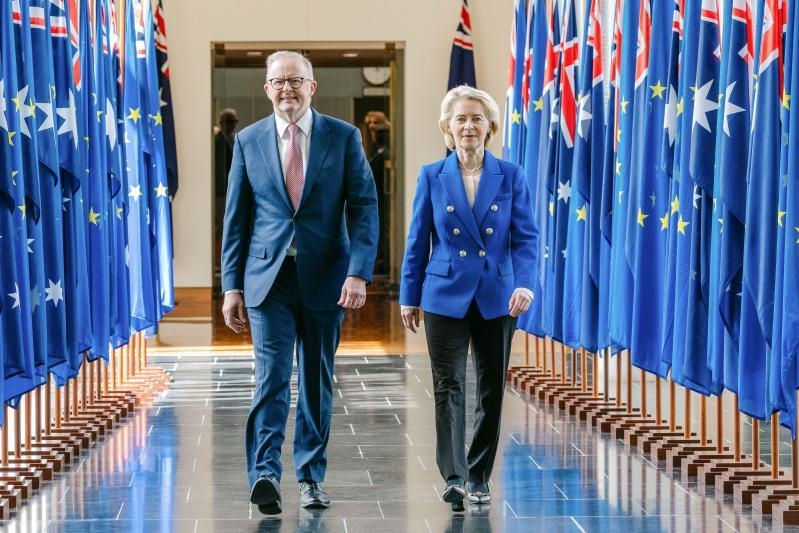
Image sourced from the European Union via the European Commission
© European Union, 1995-2026
On March 24, 2026, Australia and the European Union (EU) concluded nearly eight years of negotiations for the Australia-EU free trade agreement (FTA). The timing is not random: for both Australia and the EU, the precariousness of the relationship with the United States (US), trade dependence on China, and uncertainties induced by the war in the Middle East were all triggers for diversification. Indeed, the FTA with Australia is just one piece of the EU’s push to expedite the finalisation of trade agreements: the bloc signed with Indonesia last year, with Mercosur and India at the start of 2026, and now with Australia.
Gains and Concessions in the Australia-EU FTA
For the EU, the FTA will benefit multiple key sectors. The European luxury electric car industry will benefit from a heightened price threshold, exonerating 75% of these vehicles from tax. The FTA will also reduce or eliminate tariffs on raw materials, including aluminium, lithium, and magnesium, all essential to clean technologies like wind turbines and batteries. Simultaneously, Australia and the EU will enhance cooperation on these critical minerals—including by co-financing related projects—and on supply chain security. As the EU relies heavily on imports of critical raw materials, diversifying and securing the supply of these strategic resources through the FTA enables the bloc to mitigate supply chain disruptions, and represents a crucial step towards the continent’s 2050 climate-neutral target.
Yet, the EU had to make difficult trade-offs. The European meat industry bears the brunt of the FTA’s concessions, facing a tenfold increase in Australian beef import quotas over the next decade. Meanwhile, Australian producers can retain certain Geographical Indication (GI) labels for products, such as Prosecco (although this will be phased out for exports), Feta and Gruyère. The EU fiercely protects these GIs, trailing only China and holding the highest reported numbers for agricultural products, wines and spirits. European agricultural producers view the GI system as a crucial mechanism to protect and market their goods. It imposes strict standards on production territories, fabrication methods, and unique qualities, while enabling global consumers to trust and distinguish these products. The system also acts as a cultural hallmark safeguarding their regional identity and culinary heritage. Given the importance of the meat industry and GIs to European producers, concessions in these areas during the Australia-EU FTA negotiations have been a major sticking point, frequently stalling the agreement.
However, in a broader context, the macroeconomic impact of the Australia-EU FTA is small: for the EU, Australia ranked 16th amongst its trading partners in 2025, with EU exports to Australia only 1.4% of total exports, compared to 20.4% to the US. Furthermore, the scale of EU imports of Australian beef is dwarfed by the EU-Mercosur trade agreement: 99,000 tonnes carcass weight equivalent under the Mercosur deal, compared to just 30,600 tonnes under the Australia-EU FTA. The weak macroeconomic repercussions signal that the Australia-EU FTA is a strategic move for both parties to strengthen the relationship across multiple dimensions beyond trade.
Expanding Beyond Commercial Trade
Zooming out from the trade deal, the EU and Australia have agreed on several other areas for cooperation. A Security and Defence Partnership will see Australia and the EU increase cooperation in maritime and cybersecurity, foreign information manipulation and interference, and beyond. This agreement—signed alongside the FTA—clearly signals the complementarity of the two frameworks, and the broader cooperation strategy between the parties.
Beyond geopolitical security, this comprehensive vision actively drives human capital integration. The services and professional mobility framework established under the Australia-EU FTA will significantly ease the exchange of skilled talent. Furthermore, the agreement tackles “behind-the-border” barriers by introducing a harmonised framework for qualification recognition. This streamlined process for Australian professionals–across sectors like legal, accounting, and engineering–to have their credentials validated across EU member states should smooth cross-border operations for professional services firms, driving deeper economic integration between the two markets. In conjunction, the Innovation Mobility Pathway will enhance the Australia-EU exchange of skilled professionals and researchers to cooperate through research placements, internships and workplace-based training.
Extending the FTA beyond goods trade to labour and innovation is a symbolically significant move for both parties. This action signals strong alignment in values, but also vulnerabilities in their relationship with their long-standing yet increasingly unpredictable trade ally, the US, and growing supply chain disruptions.
Navigating Friction and Charting the Future
Before formally entering into force, the FTA still needs to be approved by the Council of the European Union and the European Parliament. As seen with Mercosur, which took over five years from the conclusion of negotiations for the trade, political and cooperation components in 2020 to its signature in 2026 and triggered protests, FTAs have become sensitive political objects, notably in the agrifood industry. Copa-Cogeca, Europe’s primary trade union of farmers and agri-cooperatives, has already denounced the EU’s concessions as sacrificing the EU’s agrifood industry and undermining its farming standards, echoing its stance in previous negotiations.
Despite the frictions of balancing asymmetrical impacts of the FTA across various industries, the EU is affirming a broader geopolitical strategy. It is positioning itself as the new pole of stability and a rules-based order and proving it can translate its ambitions into coherent policies. The Australia-EU FTA is a part of this roadmap and will have profound influence beyond trade–from joint security and defence, talent mobility, research and innovation collaborations, and more–for years to come.
Abby has experience living across Australia, Asia, and Europe, and speaks English,
Mandarin, French, and Italian. Growing up among drastically different cultures and
ideologies made her passionate about the international arena.
Abby graduated from the University of Sydney with a Bachelor of Commerce. She has
participated in study trips in Spain and Germany, as well as in an English teaching assistant program in France, where she served as an ambassador representing Australia. These experiences further deepened her interest in international affairs and cooperation, leading her to further pursue a Master's in Management at Emlyon Business School in France.
As the Europe and Eurasia Fellow, Abby is passionate about playing a part in building
stronger ties between Australia and the region. By drawing on her grassroots experiences— from extensive backpacking and local immersions to consuming regional media—she is committed to fostering a more nuanced, mutual understanding across Europe and Eurasia.
Disclaimer: The views and opinions expressed in this article are those of the author, and do not necessarily reflect the views and opinions of Young Australians in International Affairs. AI tools were used by this author for grammar checks only, but all content is original, and no plagiarism has been used in the preparation of this article.



Comments