
Career Spotlight: Gaia Trincone
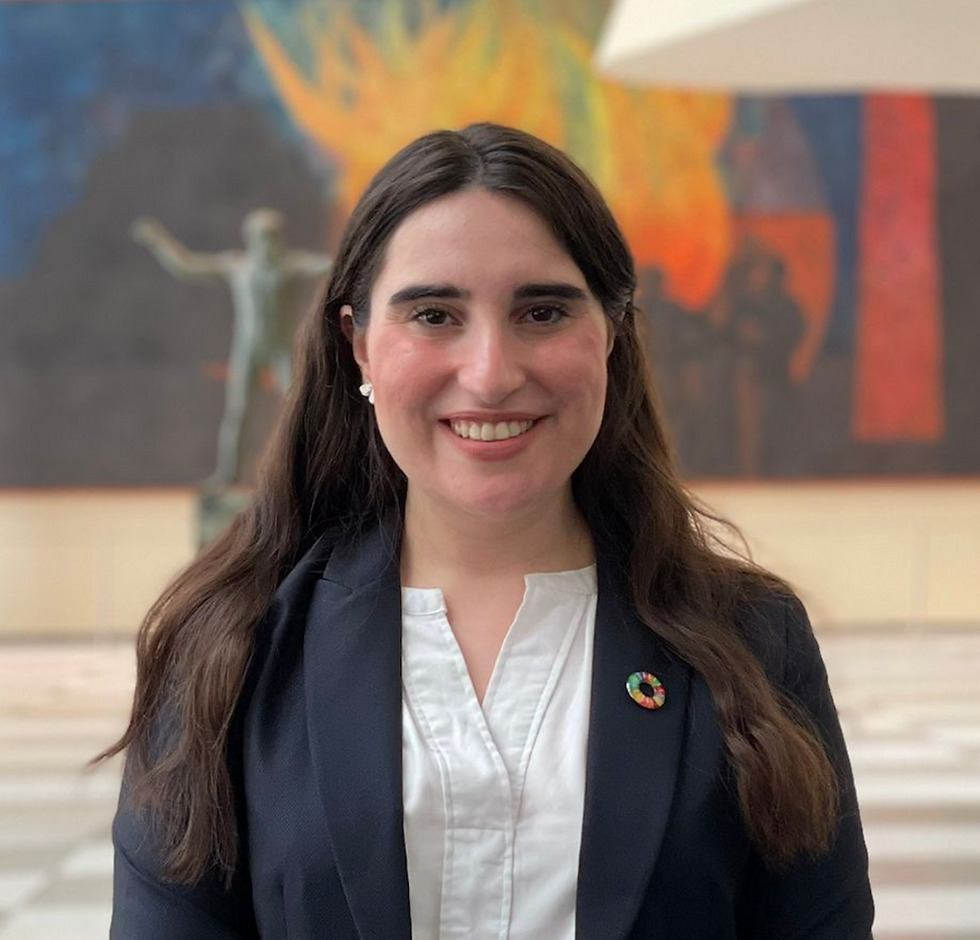
In this career spotlight, we have the pleasure of speaking with Gaia Trincone, a trainee at the German Agency for International Cooperation (GIZ). Gaia reflects on her experiences studying at top universities and the value of working across international, regional and local levels to establish her career in her chosen area of international affairs.

Gaia Trincone is a Master’s graduate in International Development from Sciences Po Paris School of International Affairs with a focus on environmental sustainability and climate change. Prior to that, she earned a Bachelor's in International Relations from The Australian National University.
Gaia’s professional experience spans international, regional, and local levels. She is currently a trainee at GIZ, Germany’s main development agency, working on climate finance. Previously, she worked on international ocean governance at the Institute for Sustainable Development and International Relations (IDDRI), and on climate change mitigation at the UNFCCC Secretariat.
You recently obtained your Master’s Degree in International Development from the renowned Sciences Po Paris School of International Affairs. How did you find your experience and what advice would you give someone considering whether and where to pursue postgraduate qualifications?
My journey at Sciences Po was highly enriching as it provided me with the knowledge, tools and mindset to really tackle today’s challenges. The school attracts people from all over the world, creating a stimulating environment where students continuously exchange and learn from each other. Additionally, being in Paris allowed me to attend numerous key events and network extensively. After completing my Bachelor’s, I felt the need to see the things I had studied in real life and contribute to them personally, and Sciences Po was the best practice ground to turn aspirations into reality. Leaving your comfort zone is never easy, but that’s where you grow the most. If you’re thinking of pursuing your studies abroad and you get an opportunity to do so, don’t be stopped, take the leap and go after your objectives with conviction. The courage will pay you off!
You’ve interned at the UNFCCC Secretariat and the Institute for Sustainable Development and International Relations and at the UNFCCC Secretariat. How did you obtain these internships, what did they entail and how did they complement your studies?
I obtained all my internships by simply applying through the positions. However, behind that, there was an enormous amount of work. I probably spent the majority of my Master’s crafting and re-crafting my career plan, attending career workshops and events, and establishing meaningful connections in and outside of school. Every person and experience contributed to my overall learning experience by making me reflect on what I truly liked and wanted. With time, I realised that I would have loved to combine my background in development economics with topics related to the environment , and possibly focus on coastal regions and small island states. All the internships I found eventually enabled me to explore my interests in one way or another. My experience at the UNFCCC exposed me to the world of climate negotiations, a perfect example of the existing divide between developed and developing countries. My work at IDDRI later allowed me to see the climate change issue from the perspective of coastal and island states who, despite being disproportionately affected by this crisis, hold enormous potential for finding solutions. Finally, my current job at GIZ is about strengthening the capacities and providing the resources needed to combat climate change.
Your study and career to date reflect your clear passion for climate change policy and ocean sustainability. What drives your passion, and what do you think are key skills to advance the policy or issue someone is passionate about?
I’ve always loved nature, and I have been educated to take care of our environment since I was a child, starting from the ‘small things’ like recycling correctly or not wasting food. My time in Australia definitely reinforced this connection and attitude towards nature, as spending time outdoors with family and friends is such a big part of the culture there. I then started learning about and becoming interested in climate change probably when the Fridays for Future movement first spread around Europe. Seeing 15-year old Greta Thunberg in the streets, begging for stronger climate action, made me realise that that was going to be one of the biggest challenges for our generation. However, the moment when I decided that issues like environmental sustainability and climate change were going to be part of my profession as well, was actually when I took a course on Pacific Politics at the ANU. For the first time, I became aware that climate change wasn’t exactly a ‘future challenge’, but a present reality, and a serious obstacle for countries’ development. Therefore, when I went on to do my Master’s in International Development, I decided to focus many of my courses on sustainability, climate change and the energy transition, and since then, I advocate for policies that see the economy, people and nature as a whole.
With regard to the second question, I would say it’s important to always remain flexible, because things do not always go as expected, especially in political fields. That said, it is especially important to always stay coherent and true to yourself. I have seen many people being sucked by organisational culture, and while this is somewhat inevitable, we must not forget that in the end, it’s people who make up organisations, so if we want policies to be more effective and ambitious, it is important that we don’t lose that ambition and motivation in the first place.
Your early career epitomises the ‘international’ in international affairs, having studied and worked in Australia, France, and Germany. What practical advice would you offer others looking to study or work abroad?
I would say that if you get an opportunity to live an experience abroad, take it, even if you feel scared. I think that, especially while you’re young, you should expand your horizons, take risks and challenge yourself. This attitude didn’t personally only make me grow as a person, but also as a professional, as you become more sensitive to the different points of view that people bring with them.
You possess certificates in Climate Reality Leadership and Synergising Disaster Risk Reduction and Climate Change Adaptation. As a UN Volunteer you supported community-led climate change adaptation projects in Papua New Guinea. How have these extracurricular qualifications and experiences given you a leg-up in your career?
Yes, during my studies, I’ve always tried to engage in some kind of extracurricular activities. They show that you’re not only interested and engaged in a topic in the classroom, but also outside of it, and that can certainly give you an advantage during a recruitment. It doesn’t necessarily have to be a heavy, long-term commitment. Nowadays, for example, a lot can be done online. Many organisations, such as the UN, often offer fully remote courses, volunteer opportunities, and even internships. Some of these can even be completed in a few hours or week, completely at your own pace. It is a great opportunity to learn more about a topic you’re interested in while also boosting your professional profile.
What does your current work at the German Agency for International Cooperation involve, and is it what you expected?
My experience at GIZ so far has fully satisfied my expectations. Working in a development implementing agency was probably my top aspiration, as I really wanted a practical and impactful job. Part of GIZ’s work consists in implementing projects around the world on behalf of different clients. The project I’m working in specifically has the objective to strengthen our partner countries’ capacities to access climate finance independently. We are engaged in developing different knowledge products, such as studies or trainings, to disseminate knowledge on climate finance topics among our partners. As part of the project, we’re also responsible for supporting with, or directly implementing, grants from the Green Climate Fund (GCF). Finally, we regularly advise our partners on GCF processes and support them, whenever needed, in each phase of their project cycle. What I love the most about my job is that it’s not only impactful, but also very varied, allowing me to truly space across different countries almost every day!
Where do you see yourself in five years?
I hope that in five years I will simply keep on doing what I like. I would definitely like to travel or move abroad again to follow projects’ implementation more closely. Eventually, I would also like to go back to university and combine the practical work with more academic research. The idea of teaching university classes also excites me! For the moment, I’m focused on opportunities closer to Europe, but I really enjoyed my time in Australia and would also love to be back one day, who knows!


Comments