
How Jordan Became the Middle East's Most Trusted Security Partner
Numan Mousa | Middle East Fellow
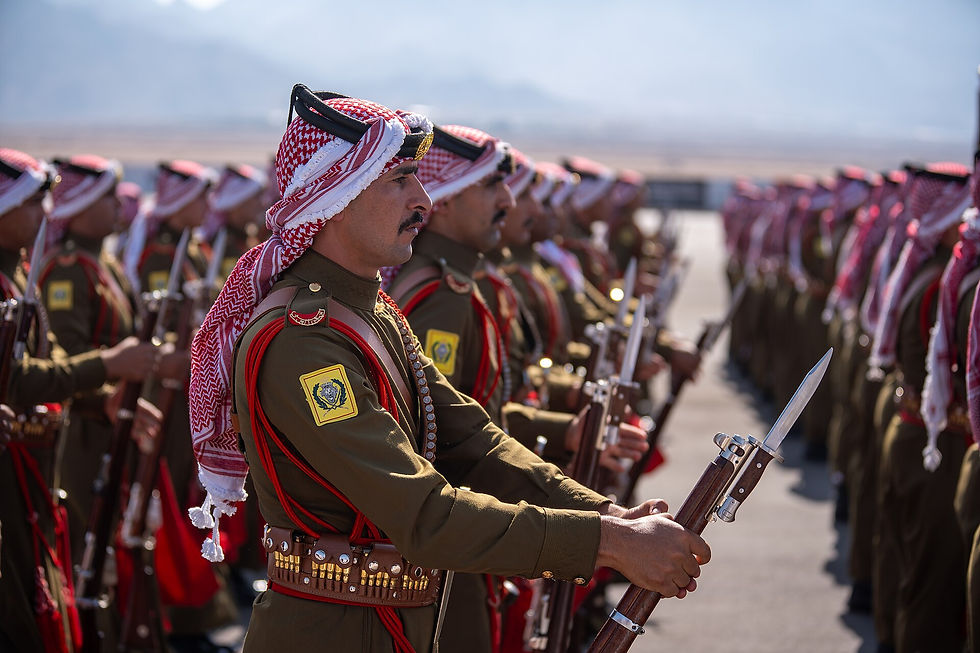
Image sourced from U.S. Army photo by Capt. Bailey Miclette via Wikimedia
The Middle East has never suffered from a shortage of military power. Aircraft carriers patrol its waters, nuclear programs simmer in its deserts, and vast armies regularly cross its borders. What the region has always lacked however, is a military partner that can be trusted by both Arab and Western countries, consistently, across decades of chaos that have broken nearly every other alliance in the neighborhood.
In a landscape full of reckless giants, one small landlocked kingdom has quietly filled that vacuum. Jordan has not done it with oil wealth or nuclear deterrence. It has done it with something difficult to build and replace: a strong reputation for reliability.
A Kingdom Forged
Founded in 1921, Jordan entered the world without the assets that define regional power— no oil, almost no water, and borders that have absorbed millions of Palestinians, Iraqis, and Syrians as neighboring states collapsed. The Jordanian Armed Forces (JAF), established in 1923, were built in that shadow. Small armies cannot afford institutional failure, and over eight decades, JAF became one of the Arab world's most professional military organizations, and a major Non-NATO ally, not in spite of Jordan's limitations, but because of them.
That culture of discipline became the base on which everything else was built. The Hashemite monarchy supplied what the region almost never produces: continuity, stable leadership, and a long strategic vision. But Hashemite durability rests on genuine popular legitimacy. In a region convulsed by polarization and collapsing public trust, Jordan's monarchy commands broad support across tribal, urban, and refugee communities alike, keeping political fragmentation low and social cohesion high. An institution the population trusts does not need to rule by fear. It polices by presence, gathers intelligence through community, and projects stability outward because it is stable within.
The Rise of the Guarantor
Jordan's emergence as one of the region's most trusted security exporter did not happen overnight. It was the product of deliberate investment, hard-won expertise, and a geographic position that forced strategic creativity in place of brute force.
When Iraq and Syria began reconstituting their armed forces, they turned to Jordanian trainers. At the King Abdullah II Special Operations Training Center (KASOTC), widely regarded as one of the world's most advanced special forces training facility, United States (US), Australian, and Gulf elite units train annually on Jordanian soil. Jordan also has a domestic defence industry, led by the Jordan Design and Development Bureau (JODDB), and developed cyber capabilities rated as the Arab world's most sophisticated. Its domestic security infrastructure, built on interlocking layers of intelligence and law enforcement, has made Jordan one of the most stable and secure countries in the Middle East.
Crucially, Jordan has also understood something its rivals have not: that reliability is a strategic asset. That track record, accumulated over decades, is why US and Gulf aid keeps flowing, and Jordan holds seats at diplomatic tables its GDP alone would never have earned.
Jordan’s role becomes clearer when compared to other regional security models. The US remains the dominant external security partner but operates with shifting political cycles and strategic failures in Iraq, Iran, and Yemen. Israel is a tactically brilliant but strategically bankrupt, with its military campaigns often being the source of insecurity in the region. Türkiye combines military strength with regional ambition, which often complicates trust among Arab partners. Iran possesses significant asymmetric reach, but its security model is viewed through an adversarial lens by much of the region. The Gulf states, meanwhile, have extensive resources but continue to rely heavily on external security providers.
The recent conflict with Iran exposed just how dangerous US partnership can be, with allies caught in the crossfire of strikes attributed to US-Israeli coordination, absorbing consequences they never signed up for.
The Model’s Ceiling
No honest accounting of Jordan's position can ignore its vulnerabilities. The kingdom relies heavily on foreign aid, that dependence creates real exposure. A shift in Washington's priorities or a cooling of Gulf generosity could rapidly erode everything Jordan has built.
Israel remains a structural security burden Jordan never asked for. The West Bank's slow annexation, Greater Israel expansionist threats, and recurring regional escalations all land disproportionately on a kingdom that shares Israel's longest Arab border and hosts the world's largest Palestinian refugee population. It is a permanent drain that no partner adequately compensates.
Jordan's reliability carries a quiet cost. By never saying no or defecting, it has repeatedly absorbed consequences it didn't create, refugee crises from wars it didn't start, and destabilized borders it didn't cause. Jordan’s reliability is often less the product of strategic freedom than of careful constraint and necessity. Yet these same constraints have also reinforced Jordan’s predictability, which is central to its strategic value.
Strategy in Plain Sight
Jordan is not the Middle East's most powerful state, but it may be its most indispensable one. What makes it irreplaceable is the combination of genuine expertise, institutional depth, political stability, and a record of reliability that no rival can match. In a region full of actors who mistake aggression for strength and noise for influence, Jordan has built something quieter and far more durable. That is not survival, but strategic relevance beyond its size.
Numan Mousa is a multidisciplinary analyst working at the intersection of human rights, diplomacy, and technology governance. He holds both Bachelor’s and Master’s degrees from UNSW and the University of Sydney, where he also served as Vice President (Externals) of the University Diplomats’ Society. Numan has applied his policy research and cyber governance expertise across the public and private sectors, including roles with the Australian Institute of International Affairs, as well as advisory positions with global firms such as Deloitte and EY in the Middle East and Indonesia. He is also an alumnus of the Global Student Fellowship, where he conducted human-rights-focused policy research in Southeast Asia.
Having been raised in Jordan, Numan brings strong regional literacy and grounded lived experience across the Middle East, shaping his understanding of governance, security, and human-impact challenges. He is committed to elevating regional perspectives in global policy discussions, promoting integrity, empathy, and contextual insight, while supporting stronger Australia-Middle East diplomatic engagement.
Disclaimer: The views and opinions expressed in this article are those of the author, and do not necessarily reflect the views and opinions of Young Australians in International Affairs. AI tools were used by this author for grammar checks and idea refinement, but all content is original, and no plagiarism has been used in the preparation of this article.


Comments