
Indonesia is Becoming a Major Power - Whether Australia is Ready or Not
- Jul 14
- 4 min read
Piper Stock | Indo-Pacific Fellow
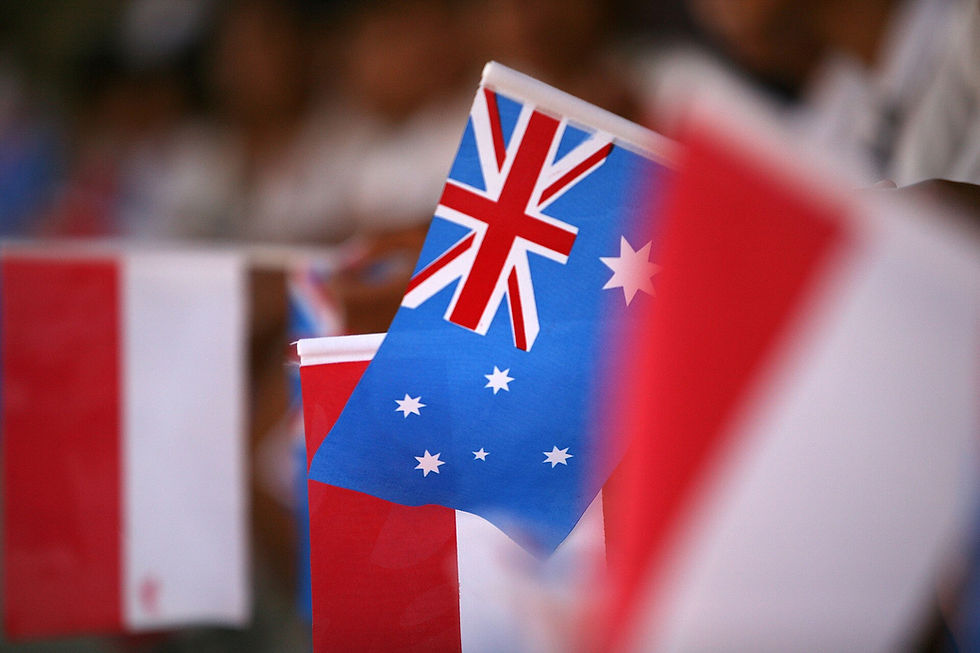
Image sourced from Mia Salim/AusAID via Wikimedia
The Neighbour We Have Never Quite Faced
Imagine waking up one morning to find that your next-door neighbour, someone you have lived beside your entire life, someone whose household decisions affect your street, your suburb, your city, has quietly become one of the most consequential people in the region. Not through conflict or crisis, but through the slow accumulation of economic, demographic, and diplomatic influence. Now imagine that, when asked, you struggle to name much about them at all.
That is, roughly, Australia's situation with Indonesia. And the gap between how significant Indonesia is becoming and how seriously Australia has taken that fact is one of the more consequential miscalculations in this country's recent foreign policy history.
A Transformation That Cannot Be Ignored
The numbers alone should concentrate the mind. Indonesia is already the world's fourth most populous nation and the eighth-largest economy by purchasing power. By 2050, on current trajectories, Indonesia is projected to rank among the four largest economies on earth, a transformation that would make it not just a regional presence but a genuine shaper of global economic gravity. Sitting astride the Lombok, Sunda, and Malacca straits, Indonesia commands the maritime chokepoints through which an enormous share of Indo-Pacific trade and naval movement flows. Any serious account of regional order must begin there, with that geography, and with what it means that the country controlling it is getting richer and more assertive at the same time.
Prabowo Subianto won Indonesia's presidential election in February 2024 and took office in October of that year, completing a political journey that had long defined Indonesian public life. A former military general and defence minister with deep roots in the Suharto era, Indonesia's authoritarian regime from 1967 to 1998, he remains a prominent and at times controversial figure whose nationalist associations have shaped both his appeal and his critics' concerns. His foreign policy instincts are not easily categorised. He has oscillated between nationalist fervour and conciliatory overtures, and his ultimate orientation toward bilateral relationships, including Australia's, remains unclear. That ambiguity should spur Australia to engage more deeply with Indonesia now, before its strategic preferences harden and Australia finds itself an afterthought in the calculations of a neighbour it failed to cultivate.
A Trade Relationship Built on Missed Opportunity
The bilateral economic relationship offers a sobering measure of how far rhetoric has outrun reality. Two-way trade has expanded significantly in recent years, reaching nearly A$35 billion in 2024-25, and yet Indonesia still ranks only ninth among Australia's trading partners – a modest position for the country next door. The Comprehensive Economic Partnership Agreement signed in 2020 provides a platform for expanding cooperation across infrastructure, tourism, education, and the digital economy, presenting one of the clearest opportunities for Australia and Indonesia to build a more substantive partnership.
The Deeper Problem: We Do Not Know Each Other
Beneath the economic and strategic picture lies something harder to quantify but perhaps more important: Australians, by and large, do not know Indonesia. Not really. Indonesia is Australia's most popular overseas destination, accounting for around 14 per cent of all overseas trips, and Indonesia consistently ranks among the top sources of international students in Australia. Yet genuine mutual understanding has not kept pace with that traffic. The unease with proximity to a large and populous Asian neighbour has never fully dissolved from Australian public sentiment, and it has simply been papered over with diplomatic pleasantries.
This matters because relationships without genuine depth do not hold under pressure. Every time Australia-Indonesia ties have deteriorated, over cattle exports, boat turnbacks, spying, the damage has been amplified by that underlying shallowness. Australia has tended to treat the relationship as a problem to be managed rather than a strategic asset to be built.
Programs designed to change that exist, but none have matched the scale of the problem. Since 2014, the New Colombo Plan has supported more than 12,000 Australian students to study or intern in Indonesia, more than any other host country. Recent reforms pledge to grow scholarship numbers, prioritise language learning, and shift toward longer immersive experiences - a tacit admission that a decade of short study tours has not delivered the depth the relationship needs. The language picture tells the same story: the number of Australian universities teaching Indonesian has fallen from 22 in 1992 to just 12 today, and high school enrolments have collapsed across every state. More universities need to offer Indonesian, and it needs to be embedded in schools long before students reach that point.
The Question Australia Cannot Afford to Defer
The central question is not whether Indonesia will matter to the Indo-Pacific. It already does, and its influence will only grow. The question is whether Australia will have built enough trust, enough trade, enough genuine partnership to hold any meaningful place in Indonesia's strategic calculations. Or whether Australia finds itself on the periphery of a regional order shaped by a powerful neighbour it never took the trouble to understand.
That is not a comfortable question. It should not be. For a generation of Australians who will inherit the Indo-Pacific that is now taking shape, the urgency is not abstract. The decisions made in the next decade, about investment, about education, about what kind of relationship Australia chooses to build, will determine whether proximity becomes partnership, or whether it simply remains proximity.
Piper is a fourth-year Bachelor of Laws and International Relations student at Griffith University. She currently works as a Federal Electorate Officer in the Australian Parliament, where she undertakes policy research, drafts parliamentary correspondence, and supports constituents on a range of federal matters. She also has professional experience in the legal sector as a Legal Administrator.
Piper is actively engaged in leadership and public service. She is a Board Member of the Griffith University Student Guild, a Gold Coast Mayor’s Student Ambassador, and a mentor for Political Science and International Relations students at Griffith University. She has also been recognised with the Griffith Business Leadership Award.
Through this fellowship, Piper hopes to combine her strong interest in the Indo-Pacific region with her professional experience to explore how domestic policy, diplomacy, and regional cooperation intersect in shaping Australia’s engagement with its nearest neighbours.
Disclaimer: AI tools were used by this author for editorial assistance, including grammar checks, phrasing suggestions, layout and structural refinement but all content is original and no plagiarism has been used in the preparation of this article.


Comments